The Modern Equity Research Stack
How AI is redefining how research teams think, decide, and invest. A framework for building systems where truth is foundational, relevance is orchestrated, and insight compounds.
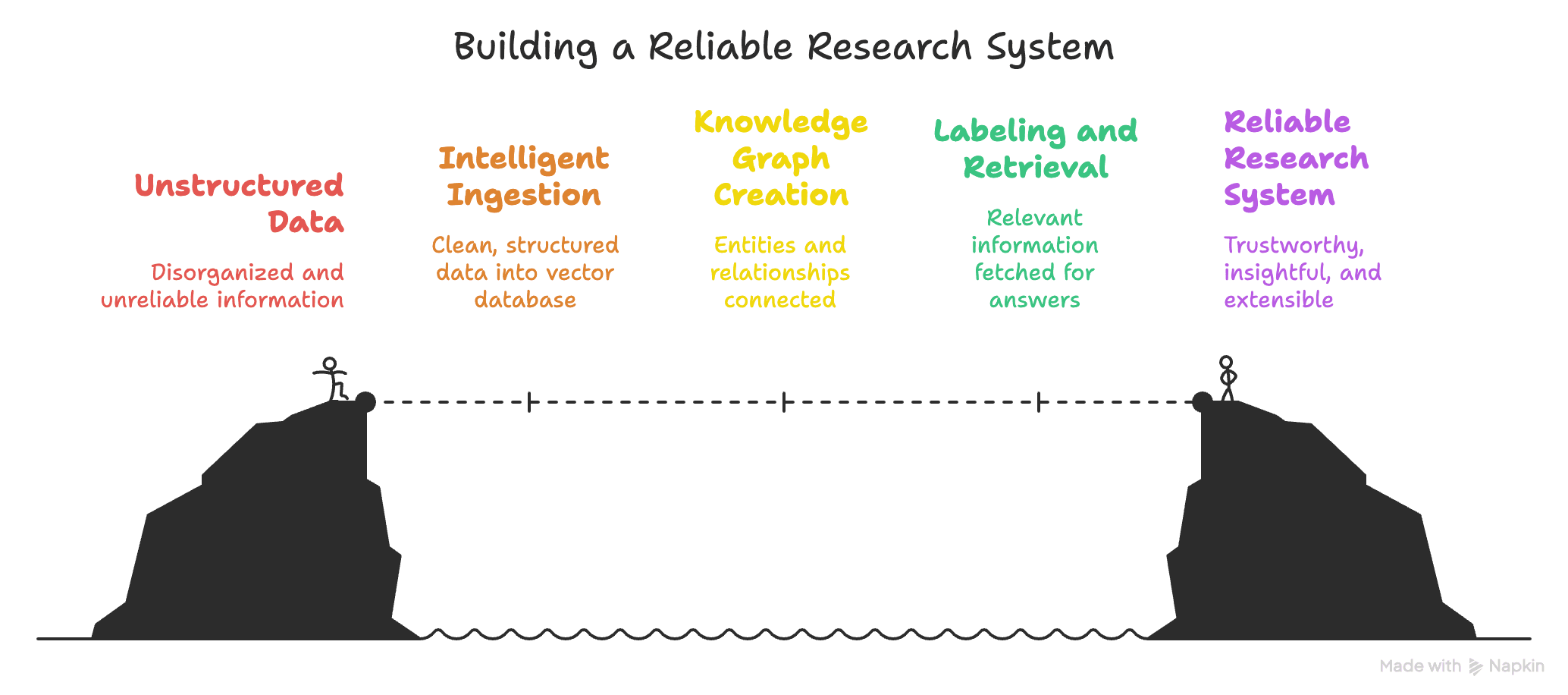

Equity research today is no longer about access to information — it's about orchestrating intelligence.
Analysts are overwhelmed by filings, earnings calls, alternative data, news, regulations, and real-time signals. The competitive edge no longer comes from seeing more data, but from structuring, prioritizing, and activating it faster and more reliably than others.
At its core, the modern equity research stack answers one question:
"Can I trust this insight — and act on it faster than everyone else?"
To do that, research systems must be built as a pyramid, where each layer reduces noise and increases decision confidence.
The Four-Layer Stack
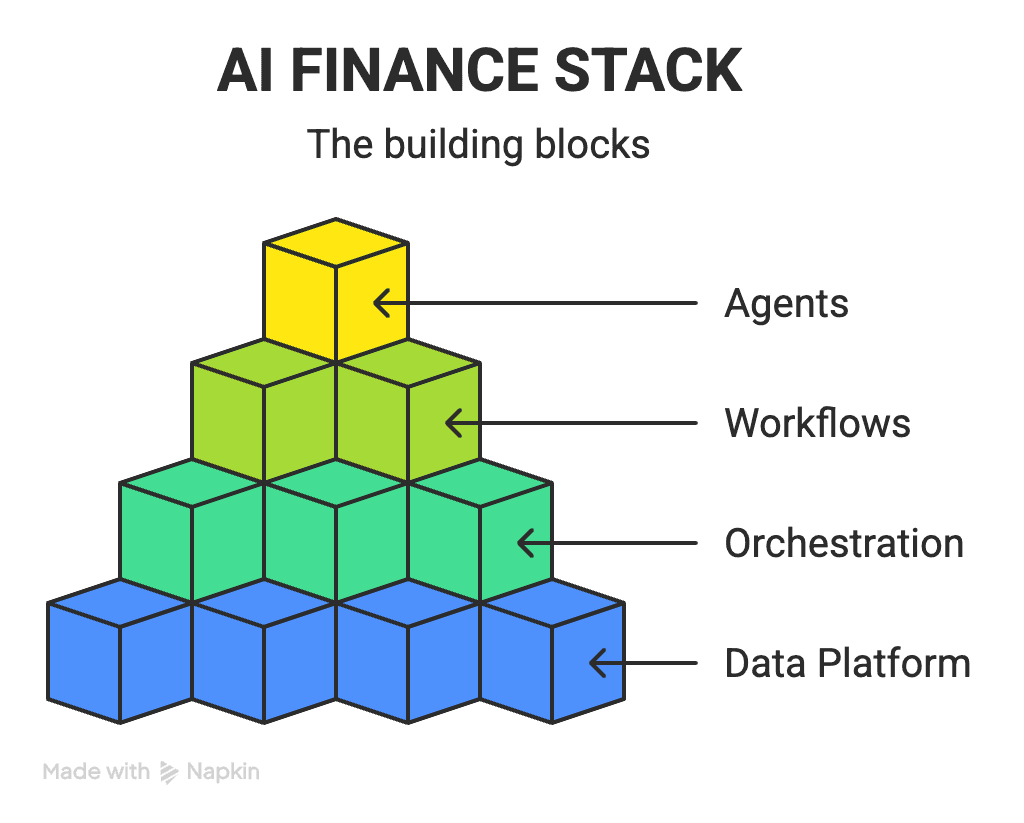
1. The Data Platform — The Foundation of Truth
Every modern research system starts with a data platform designed for intelligence, not storage.
Intelligent Data Ingestion
All research begins with clean, structured ingestion:
- Financial filings, earnings transcripts, news, regulations, social and alternative data
- Parsed with correct metadata, entity resolution, and embeddings
- Designed for semantic understanding, not keyword search
Poor ingestion leads to weak correlations — and weak insights.
Knowledge Graphs That Understand Context
Once ingested, data is organized into a living knowledge graph:
- Entities: companies, executives, sectors, geographies
- Relationships: supply chains, peers, regulatory exposure
- Temporal context: what changed, when, and why
This enables cause–effect reasoning, not just retrieval.
Context, Labeling & Retrieval Logic
Every data asset is labeled so that:
- Retrieval systems fetch only relevant information
- Context sufficiency is validated before answers are generated
- No context → no output
Guardrails That Preserve Trust
Institution-grade research requires controls:
- Every claim traceable to source data
- Evidence-backed outputs
- Domain-aware logic enforcement
The Data Platform's Role
Extract signal, eliminate noise, and establish truth.
2. Orchestration — Turning Signal Into Intent
If the data platform defines what is true, orchestration decides what matters now.
This layer evaluates signals coming out of the data foundation and determines:
- Which changes are material
- Which events require action
- Which analyses should run — and in what order
Orchestration is driven by:
- Time (earnings, market open/close)
- Events (filings, guidance changes, anomalies)
- Thresholds (material KPI or valuation shifts)
Without orchestration:
- Workflows run unnecessarily
- Insights arrive too late
- Agents act on stale or irrelevant information
Key Insight
Orchestration ensures that only meaningful signals propagate upward.
3. Workflows — Where Analysis Gains Mass
Workflows are where intelligence turns into action.
Triggered by orchestration, workflows are structured, repeatable analytical processes that continuously interact with the data platform. As they run, re-run, and refine, they accumulate analytical depth.
Core Research Workflows
Morning Intelligence Briefing
- Overnight news and disclosures
- Sector and macro signals
- Regulatory and policy changes
- Delivered as signal, not noise
Bottom-Up Company Deep Dives
- Financial performance and unit economics
- Management quality and governance patterns
- Competitive positioning and growth drivers
- All grounded in verifiable data
Top-Down Sector Research
- Structural shifts and secular trends
- Peer benchmarking across key metrics
- Identifying divergence before consensus
Financial Modeling & Decision Support
- AI-assisted assumption validation
- Scenario analysis grounded in history
- Faster iteration with higher confidence
KPI Tracking Over Time
- Longitudinal monitoring
- Early detection of inflection points
- Cross-sector and custom universe comparison
Living Systems
Workflows are not static scripts — they are living analytical systems that grow more precise as new signals arrive.
4. Agents — Synthesis, Narrative, and Decision Interface
At the top of the stack sit the agents.
Agents do not create truth. They observe, synthesize, and communicate it.
Their role is to:
- Interpret workflow outputs
- Resolve ambiguity and conflicts
- Translate structured analysis into narratives, comparisons, and recommendations
- Interact with humans in natural language
Crucially, agents are constrained by the layers below:
- No direct access to raw data
- No bypassing workflows
- No unsupported reasoning
Their strength comes from standing on accumulated certainty.
The Outcome: Research That Compounds
When built as a pyramid, the modern equity research stack delivers:
- Speed without sacrificing rigor
- Depth without fragmentation
- Trust without manual verification
Analysts spend less time searching and validating — and more time thinking, debating, and deciding.
Final Thought
In the AI-first era, alpha is no longer about who has the most data.
It's about who has the best system to turn data into decisions — one where truth is foundational, relevance is orchestrated, analysis compounds through workflows, and insight is clearly expressed through agents.
Build Your Stack
The question isn't whether to adopt AI in research. It's whether your stack is designed to compound intelligence — or just process information.
Enjoyed this article?
Get more insights like this delivered to your inbox weekly.


